-
-
W-199-E, MIDC Khairne, Thane Belapur Road, Navi Mumbai – 400705. India.
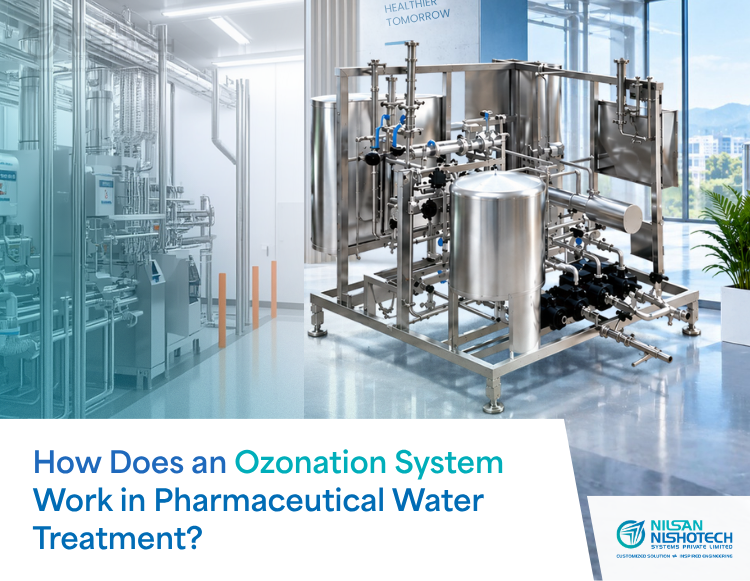
How Does an Ozonation System Work in Pharmaceutical Water Treatment?
21 Sep 2026
How Does an Ozonation System Work in Pharmaceutical Water Treatment?
An ozonation system in pharmaceutical water treatment uses ozone (O₃), a powerful oxidizing agent, to control microorganisms and help maintain the microbiological quality of purified water. Ozonation is widely considered for water sanitization in the pharmaceutical and biopharma industry, where maintaining hygienic water systems is critical for consistent manufacturing and product quality.
What Is Ozonation in Pharmaceutical Water Treatment?
Ozonation is a water sanitization process in which ozone is generated and introduced into a controlled water stream. Because ozone has strong oxidation properties, it can react with microorganisms, organic contaminants, and other oxidizable substances.
Unlike some conventional chemical sanitization methods, ozone decomposes into oxygen, leaving no persistent chemical disinfectant when properly controlled. This makes it a useful technology for pharmaceutical water systems when designed, monitored, and validated according to the application's requirements.
How Does an Ozonation System Work?
An ozonation system generally follows several controlled steps:
- Ozone generation: Oxygen or oxygen-enriched gas is passed through an ozone generator to produce ozone.
- Ozone injection: The generated ozone is introduced into the pharmaceutical water through an appropriate injection or contact arrangement.
- Contact and oxidation: Ozone remains in contact with the water for a defined period, allowing oxidation and microbial inactivation to occur.
- Monitoring: Ozone concentration, contact conditions, temperature, and other critical parameters can be monitored according to the system design.
- Ozone decomposition: Ozone naturally breaks down into oxygen. In applications where residual ozone must be controlled, suitable ozone destruction or removal arrangements may be incorporated.
The exact configuration depends on water quality, system capacity, sanitization strategy, and the intended pharmaceutical application.
Why Is Ozone Used in Pharmaceutical Water Systems?
Ozone can provide several potential advantages for pharmaceutical water systems. Its strong oxidation capability supports microbial control throughout suitable storage and distribution environments. It can also help reduce biofilm formation when the system is appropriately designed and operated.
For the biopharma industry, where water quality and microbial control are important operational considerations, ozonation can be integrated into a broader water treatment and sanitization strategy.
However, ozonation should not be viewed as a standalone solution for every application. System design, water quality, materials of construction, ozone concentration, contact time, monitoring, and validation requirements all need to be considered.
What Are the Key Parameters to Monitor?
Effective ozonation requires control of critical operating parameters. Depending on the application, these may include:
- Ozone concentration or residual ozone
- Water temperature
- Contact time
- Flow rate
- Dissolved ozone
- Microbiological quality
- System pressure and operating conditions
Regular monitoring helps demonstrate that the sanitization process is operating consistently and supports the overall control strategy of the pharmaceutical water system.
Is Ozonation Suitable for the Biopharma Industry?
Yes, ozonation can be considered for suitable biopharma water treatment applications where microbial control and hygienic storage and distribution are important. Its suitability depends on the required water grade, process design, material compatibility, validation strategy, and applicable quality requirements.
A properly engineered system should be designed around the specific application rather than using a one-size-fits-all approach.
Benefits of an Ozonation System
An appropriately designed ozonation system may offer:
- Effective microbial control
- Support for hygienic water storage and distribution
- Reduction of biofilm risk
- No persistent chemical disinfectant after ozone decomposition
- Automated and measurable sanitization
- Integration with pharmaceutical water treatment systems
Frequently Asked Questions
1. What is an ozonation system?
It is a water sanitization system that generates ozone and uses its oxidation properties to control microorganisms and oxidizable contaminants.
2. How does ozone disinfect pharmaceutical water?
Ozone oxidizes microbial cell components and other susceptible substances, helping achieve microbial control under controlled conditions.
3. Is ozone better than traditional chemical sanitization?
Not necessarily. The appropriate sanitization method depends on the water system, application, validation requirements, materials, and operational strategy.
4. Can ozone be used in pharmaceutical water distribution systems?
Yes. It can be incorporated into suitable storage and distribution systems when properly engineered, monitored, and validated.
5. Why is ozone useful in the biopharma industry?
It can support microbial control and hygienic water management, which are important considerations in biopharmaceutical manufacturing.
Conclusion
An ozonation system in pharmaceutical water treatment can be an effective component of a controlled microbial management strategy. By generating ozone, introducing it into the water, providing adequate contact conditions, monitoring critical parameters, and managing ozone decomposition, pharmaceutical manufacturers can support hygienic water storage and distribution.
For pharmaceutical and biopharma industry applications, successful ozonation depends on proper engineering, material compatibility, process control, monitoring, and validation. Choosing the right configuration based on the specific water system is essential for reliable and consistent performance.
To discuss your pharmaceutical water treatment requirements, contact Nilsan Nishotech at info@nilsan-nishotech.com.