-
-
W-199-E, MIDC Khairne, Thane Belapur Road, Navi Mumbai – 400705. India.
What Is a Pharmaceutical Process Mixing Vessel and How Does It Work?
21 Sep 2026
What Is a Pharmaceutical Process Mixing Vessel and How Does It Work?
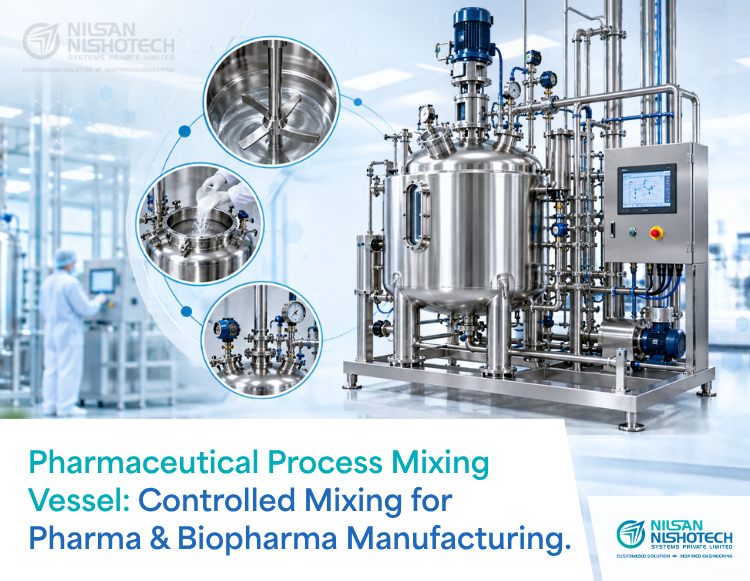
A pharmaceutical process mixing vessel is a purpose-designed vessel used to mix, formulate, prepare, and sometimes hold pharmaceutical products or intermediates under controlled processing conditions. In the pharmaceutical and biopharma industries, these vessels support consistent mixing, hygienic processing, controlled temperature, and reliable batch production.
A properly designed vessel should suit the formulation, batch size, operating conditions, cleaning requirements, and production environment. FDA GMP guidance emphasizes that manufacturing equipment should be appropriately designed, adequately sized, suitable for cleaning and maintenance, and operated within its qualified range.
What Is a Pharmaceutical Process Mixing Vessel?
A process mixing vessel is a controlled manufacturing vessel where raw materials, solutions, or formulation ingredients are combined and processed to achieve the required product characteristics.
Depending on the application, a vessel may support:
- Formulation and batch preparation
- Solution preparation
- Homogeneous mixing
- Intermediate storage
- Controlled heating or cooling
- Aseptic or hygienic processing
For pharma and biopharma manufacturing, the vessel design should support process consistency while minimizing contamination and cross-contamination risks.
How Does a Pharmaceutical Mixing Vessel Work?
The basic principle is simple: ingredients are introduced into the vessel and mixed using an agitator designed for the formulation and required processing conditions.
The agitator creates controlled movement inside the vessel, helping distribute materials throughout the batch. Mixing performance depends on factors such as product viscosity, batch volume, agitator configuration, speed, and formulation characteristics.
Instrumentation can provide information about important process conditions, allowing operators to monitor and control the batch according to established procedures.
What Are the Key Features of a Process Mixing Vessel?
A pharmaceutical process mixing vessel can be configured with features such as:
- SS 316L construction for product-contact surfaces
- Surface finish of ≤ 0.38 Ra, based on the specified vessel design
- Agitators suited to the process
- Load cells for controlled weighing and batch monitoring
- Pressure and temperature sensors
- CIP/SIP integration where required
- Process control and automation
The actual configuration should be based on the formulation, operating requirements, cleaning strategy, and intended application.
Why Does Stainless Steel and Surface Finish Matter?
Material selection and surface condition are important in hygienic pharmaceutical equipment. FDA guidance states that equipment product-contact surfaces should not adversely affect product quality and that equipment should be suitable for cleaning and maintenance.
For pharmaceutical water and hygienic systems, WHO also identifies stainless steel 316L and smooth internal finishes as commonly used considerations.
What Should Project Teams Verify Before Selection?
Project teams should review vessel capacity, product characteristics, agitator requirements, temperature and pressure conditions, instrumentation, cleaning approach, automation, material compatibility, and future production needs.
How Does Vessel Design Affect Cleaning?
Equipment geometry and product-contact surfaces can influence how effectively a vessel can be cleaned. Cleaning procedures should be established and, where applicable, validated for the specific equipment and process. FDA guidance emphasizes that cleaning procedures must be appropriate to the equipment design, material, and substances being processed.
Why Is Agitation Important in Pharmaceutical Manufacturing?
Agitation is one of the most important elements of a mixing vessel. The correct agitator helps achieve the desired level of blending and uniformity without unnecessarily damaging the formulation.
Different products may require different mixing patterns. Low-viscosity liquids, viscous formulations, suspensions, and other materials may behave differently during processing.
Therefore, agitator selection should be based on actual product and process characteristics rather than vessel size alone.
What Is the Role of CIP and SIP?
Cleaning and sterilization requirements should be considered during equipment selection and system design.
CIP, or Clean-in-Place, allows defined cleaning procedures to be performed without extensive equipment disassembly. SIP, or Sterilize-in-Place, may be incorporated where the process requires in-place sterilization.
The suitability of CIP or SIP depends on the equipment design, process, materials, cleaning or sterilization method, and validated requirements. Proper cleaning is particularly important in multiproduct manufacturing to reduce contamination and carryover risks.
Where Are Process Mixing Vessels Used?
Process mixing vessels can be used for a range of pharmaceutical and biopharma applications, including formulation, solution preparation, intermediate processing, and controlled holding.
For aseptic or hygienic manufacturing environments, the vessel should be integrated with the facility's overall process, utilities, monitoring, cleaning, and quality requirements.
How Can Automation Improve Mixing Vessel Operations?
Automation can help monitor and control defined process parameters such as temperature, pressure, mixing speed, batch weight, and operating sequence.
Load cells can support accurate material or batch measurement, while sensors provide process information to operators and control systems.
The objective is to improve repeatability and process visibility while keeping the system within approved operating conditions.
How Should Pharma and Biopharma Companies Choose a Mixing Vessel?
Plant Heads and Project Managers should consider more than initial vessel capacity. Key questions include:
- Does the vessel match the formulation?
- Is the agitator suitable for the product?
- Are the required temperature and pressure conditions supported?
- Can the vessel be cleaned effectively?
- Are CIP/SIP requirements addressed?
- Can instrumentation and automation be integrated?
- Does the design support future production requirements?
A well-matched vessel can support consistent processing, easier operation, maintenance planning, and long-term production needs.
Pharmaceutical Process Mixing Vessels for Biopharma Applications
In the pharmaceutical and biopharma industries, process equipment needs to support controlled manufacturing while considering hygiene, product quality, cleaning, maintenance, and documentation.
A process mixing vessel should therefore be evaluated as part of the complete manufacturing process rather than as an isolated piece of equipment. Its mechanical design, instrumentation, agitation, cleaning strategy, and automation should work together to meet the intended process requirements.
Frequently Asked Questions
What is a pharmaceutical process mixing vessel?
It is a manufacturing vessel designed to mix, formulate, prepare, or hold pharmaceutical materials under controlled processing conditions.
Why is SS 316L used in pharmaceutical vessels?
SS 316L is commonly selected for hygienic product-contact equipment because of its suitability for pharmaceutical manufacturing environments and cleaning requirements.
What is the role of an agitator?
An agitator creates controlled movement within the vessel to help distribute and mix formulation ingredients consistently.
Are CIP and SIP necessary for every mixing vessel?
Not necessarily. Their use depends on the formulation, process, equipment design, and applicable cleaning or sterilization requirements.
Can a mixing vessel be customized?
Yes. Vessel capacity, agitator configuration, instrumentation, load cells, sensors, automation, and cleaning provisions can be designed according to specific process requirements.
Conclusion
A pharmaceutical process mixing vessel is a critical part of controlled formulation and batch manufacturing. The right vessel combines suitable materials, effective agitation, appropriate instrumentation, hygienic design, cleaning capability, and process control.
For pharmaceutical and biopharma manufacturers, selecting a vessel based on formulation, production capacity, cleaning requirements, automation, and future needs can support consistent and reliable processing.
Nilsan Nishotech develops process equipment solutions around specific manufacturing requirements, helping pharma and biopharma organizations plan equipment that aligns with their processes and production goals.
For process mixing vessel requirements and technical discussions, contact Nilsan Nishotech at info@nilsan-nishotech.com.