-
-
W-199-E, MIDC Khairne, Thane Belapur Road, Navi Mumbai – 400705. India.
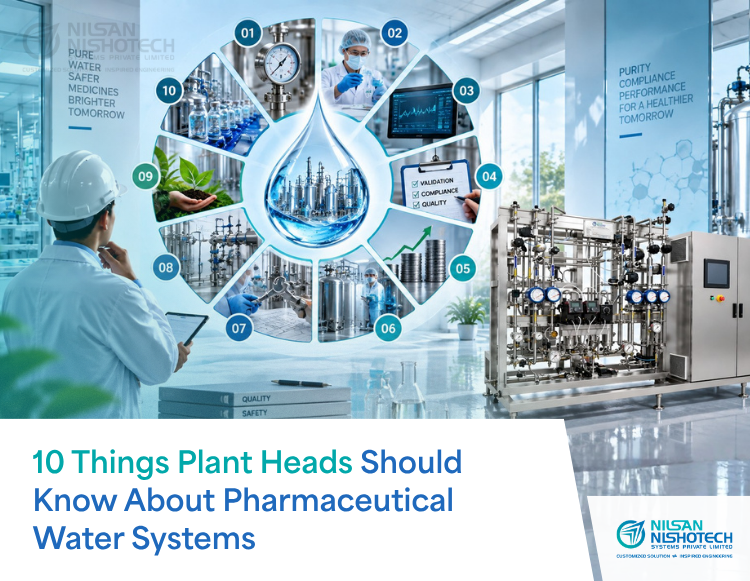
10 Things Plant Heads Should Know About Pharmaceutical Water Systems
21 Sep 2026
10 Things Plant Heads Should Know About Pharmaceutical Water Systems
For Plant Heads in the pharmaceutical and biopharma industries, a reliable pharmaceutical water system is directly connected to production continuity, product quality, maintenance planning, and inspection readiness. A water system should not be viewed simply as a utility. Its design, operation, monitoring, maintenance, and documentation all contribute to keeping water quality under control. FDA and WHO guidance both emphasize system design, monitoring, validation, sampling, maintenance, and documented control when evaluating pharmaceutical water systems.
1. Start With the Intended Water Quality
The first question should be: What quality of water does the process actually require?
The required water grade depends on the intended pharmaceutical application. Plant Heads should make sure the water-system design is aligned with manufacturing needs, quality specifications, and the products using the water.
2. System Design Matters as Much as Water Generation
Producing high-purity water is only one part of the job. Storage and distribution must also protect water quality.
Plant Heads should review the overall system design, including piping, circulation, sampling points, points of use, and areas where stagnant water could occur. WHO inspection guidance recommends checking current drawings against the installed system and reviewing visible pipework and user points.
3. Keep the Distribution Loop Under Control
Water quality can change after generation if the distribution system is not properly managed.
A well-controlled distribution system should support appropriate circulation, temperature control where applicable, sanitization, sampling, and reliable delivery to points of use. FDA inspection guidance specifically highlights dead legs, leaks, sanitary connections, and distribution-system conditions as areas requiring attention.
4. Monitor More Than Individual Test Results
Plant Heads should look beyond whether a single result passes or fails.
Routine monitoring may include parameters such as conductivity, TOC, temperature, flow, pressure, and microbiological quality, depending on the system and its intended use. WHO recommends trend analysis and appropriate alert and action levels so that developing changes can be investigated.
Why Is Trend Analysis Important? A gradual change can be more informative than a single isolated result. Reviewing historical data helps teams recognize patterns and investigate potential issues before they become larger problems.
5. Validation Is an Ongoing Responsibility
A validated pharmaceutical water system should demonstrate consistent performance over time, not only during initial qualification.
Plant Heads should ensure that qualification and validation records are maintained and that routine operation continues to follow approved procedures. WHO guidance includes qualification activities such as DQ, FAT, IQ, SAT, OQ, and PQ or equivalent verification.
6. Maintenance Can Directly Affect Reliability
Water-system performance depends on the condition of equipment and instruments.
Preventive maintenance, corrective maintenance, failure records, repair history, and calibration of critical instruments should be properly managed. WHO inspection guidance specifically identifies maintenance, failure and repair logs, and calibration as areas for review.
What Should Plant Heads Track? Useful operational indicators include recurring failures, frequent alarms, maintenance trends, deviations, and changes in water-quality results. These can help maintenance and operations teams identify recurring problems instead of repeatedly treating symptoms.
7. Sampling Points Need a Clear Strategy
Sampling is not simply about collecting water and sending it for testing.
Plant Heads should ensure that sampling locations are appropriately defined and that the sampling and monitoring plan reflects the complete water system. WHO guidance recommends documented sampling plans, sample-point drawings, defined sampling procedures, and suitable flushing and drainage procedures.
8. Documentation Should Match the Actual Plant
One of the simplest but most important questions is: Does the documentation still match what is physically installed?
Current P&IDs, system drawings, sampling-point details, monitoring records, validation documents, maintenance records, and change-control information should remain accurate and traceable. WHO inspection guidance specifically calls for checking that the water system matches the P&ID or drawing.
9. Plan for Deviations and Unexpected Events
No operating system is completely free from deviations. What matters is how effectively the organization responds.
When monitoring results exceed established limits or unusual trends appear, the issue should be investigated through the facility's quality procedures. The investigation should consider system history, potential causes, and possible impact on manufacturing. FDA inspection guidance recommends reviewing monitoring data and investigation reports when water-system values exceed established limits.
10. Think Beyond Today's Production Capacity
A water system designed only for current requirements may become a limitation when production expands.
Plant Heads and Project Managers should consider future capacity, additional points of use, operating requirements, maintenance access, monitoring needs, and potential plant expansion during system planning.
A scalable design can make future modifications easier while reducing the risk of major operational disruption.
What Should Plant Heads Review Regularly?
A practical review can focus on seven questions:
- Is water quality consistently within established requirements?
- Are system drawings current?
- Are monitoring trends being reviewed?
- Are deviations properly investigated?
- Are maintenance and calibration records current?
- Is the distribution system operating as intended?
- Is the system prepared for inspection and future production needs?
Regular self-inspection can help pharmaceutical and biopharma facilities identify gaps before a regulatory inspection. WHO specifically recommends routine audit and self-inspection of established water systems.
How Nilsan Nishotech Supports Pharmaceutical Water Systems
Nilsan Nishotech focuses on high-purity water systems for the pharmaceutical and biopharma industries, with an emphasis on reliable system engineering and application-specific requirements.
For Plant Heads, the priority is not only getting high-purity water from the system. It is maintaining consistent quality across the complete lifecycle, from generation and storage through distribution, monitoring, maintenance, and ongoing operational control.
A well-planned pharmaceutical water system can support production reliability, quality management, and long-term plant performance.
Frequently Asked Questions
Why is a pharmaceutical water system important?
It provides controlled-quality water required for defined manufacturing, cleaning, laboratory, and other pharmaceutical applications.
What parameters should be monitored?
Depending on the system, monitoring may include conductivity, TOC, temperature, flow, pressure, and microbiological quality.
How often should a pharmaceutical water system be reviewed?
Routine monitoring should be supported by periodic system review, maintenance, calibration, trend analysis, and self-inspection according to the facility's procedures and applicable requirements.
What is one major risk Plant Heads should watch for?
Loss of control in the distribution system, including stagnant areas, inadequate monitoring, maintenance issues, or unexplained changes in water quality, can create significant operational and quality concerns.
Why should Plant Heads consider future expansion?
Capacity changes and additional points of use can affect system design, monitoring, distribution, and maintenance. Planning early can reduce the need for disruptive modifications later.
Conclusion
For Plant Heads, a pharmaceutical water system should be managed as a critical part of the manufacturing infrastructure. Water quality, system design, distribution, monitoring, validation, maintenance, documentation, and future capacity all need continuous attention.
In the pharmaceutical and biopharma industries, the goal is not simply to produce high-purity water. The goal is to maintain consistent system control while supporting reliable production and inspection readiness.
Nilsan Nishotech supports pharmaceutical and biopharmaceutical manufacturers with high-purity water-system solutions designed around their specific process and operational requirements.
For high-purity water system solutions for pharmaceutical and biopharma applications, contact Nilsan Nishotech at info@nilsan-nishotech.com.